The Sharpest
I-PEX株式会社(本社:京都府京都市、代表取締役社長執行役員:小西 玲仁、以下 I-PEX)は、次世代のリチウムイオンバッテリーにおいて、シリコン系活物質の密着性や導電性を改善することでバッテリーの性能向上に貢献する集電体「三次元不織布集電体」を開発中です。
本技術の実物サンプルおよび技術解説資料を、2025年11月18日(火)から20日(木)に愛知県・ウインクあいちで開催される「第66回電池討論会 併設展示会」の I-PEX ブース(6F No.15)で展示します。
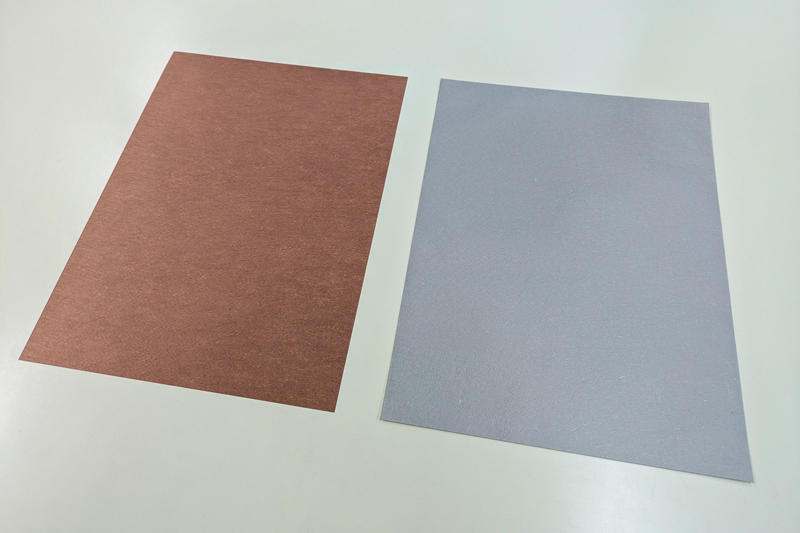 Advanced Conductive Mesh (left: copper-metallized product, right: aluminum-metallized product)
Development Background
Recently, to increase the capacity of next-generation lithium-ion batteries, silicon-based active materials—whose theoretical capacity is more than ten times that of graphite-based active materials—are expected to be used. However, silicon-based active materials undergo approximately fourfold volume changes during charge and discharge cycles. These volume changes cause the active material to peel away from the copper foil, which is generally used as the negative electrode current collector. This issue has hindered the widespread adoption of silicon-based active materials.
I-PEXは本課題を解決する手段として、コネクタ事業におけるコネクタ一貫生産で培った表面処理技術やノウハウを活用することで、不織布に負極向けの銅や正極向けのアルミニウムによる表面処理を施した立体的な表面構造や空隙をもつ「三次元不織布集電体」を開発しました。
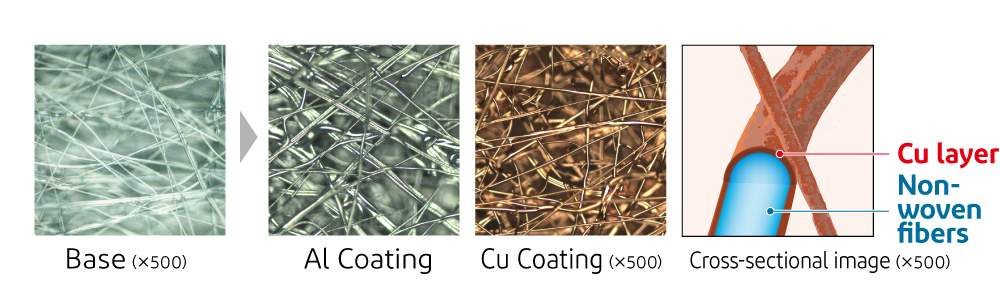 Enlarged view of advanced conductive mesh
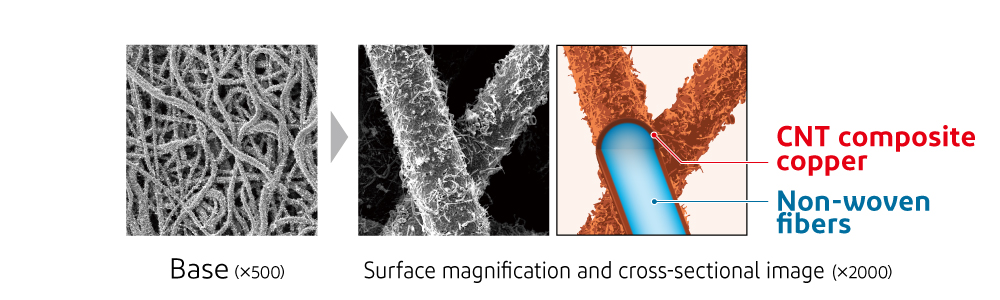 CNT composite plating on nonwoven fibers
Features of the Advanced Conductive Mesh
The advanced conductive mesh is expected to improve issues such as the adhesion and conductivity of silicon-based active materials in next-generation lithium-ion batteries, thereby contributing to improved battery performance
- The complex and flexible structure of the nonwoven fabric holds the active material in place, preventing peeling caused by the expansion and contraction of the silicon-based active material
- Metallization of nonwoven fabric ensures a high specific surface area of the current collector and electrical conductivity comparable to that of copper foil
- The conductive nonwoven fabric forms a conductive path throughout the active material layer, improving the utilization rate of the active material
- The current collector is made lighter by using a resin nonwoven fabric as the base material
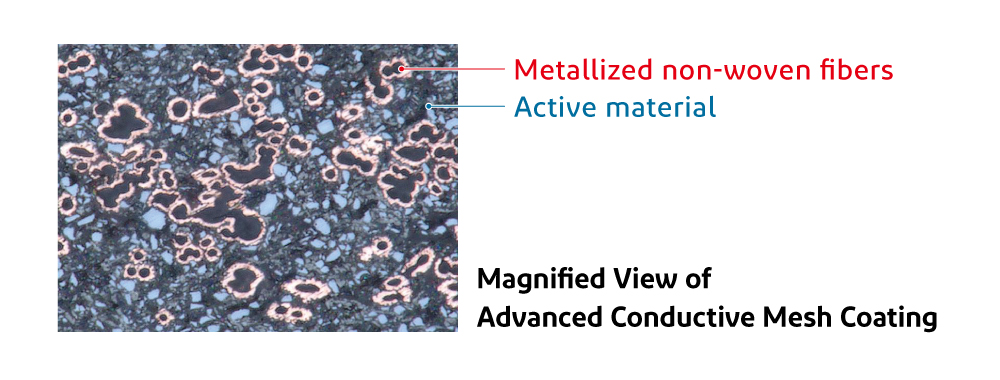 Cross-section of advanced conductive mesh
Cycle Test Results for Advanced Conductive Mesh
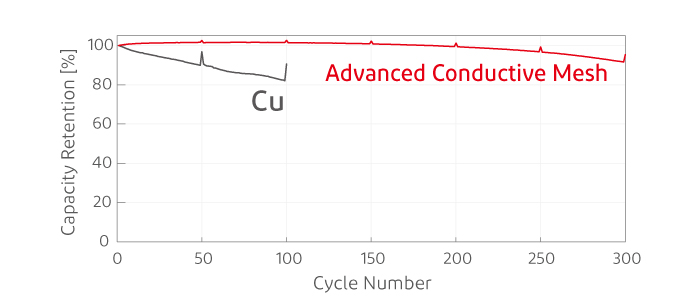 Advanced conductive mesh cycle test results
In this test, a lithium-ion battery with an anode containing over 65% silicon was prototyped using an advanced conductive mesh made by plating copper on nonwoven fabric, and performance was compared after 300 charge/discharge cycles. Compared with the reference copper foil, it was confirmed that the advanced conductive mesh improves cycle performance by holding the active material within the metallized nonwoven fabric fibers. It was also confirmed that the battery has good compatibility with solvent-based binders.
| Cell | Laminate Cell/Electrode (One side) |
|---|---|
| Cathode | LiCoO2 type |
| Anode | Pure Si type (Anode Capacity: ca. 2800 mAh/g) |
| Separator | Al2O3 Coated PE, 12 μmt |
| Electrolyte | 1.2M LiPF6 in EC/EMC/DMC/FEC +Additives |
| Cell Capacity | 25 mAh (2.1 mAh/cm2) |
| Cycle Condition |
[Temp.] 25 ℃ [Charge] 0.5 C_4.2 V CC/CV 0.05 Ccut_Rest: 10 min. [Discharge] 0.5 C_CC 2.5 Vcut_Rest: 10 min. *0.2 C/0.2 C for every 50 cycles |
Specifications of the Advanced Conductive Mesh
| Substrate type | PET or PBT *1 |
|---|---|
| Thickness, basis weight | Thickness: 150-180 μm, weight: 35-50 g/m 2 *1 |
| Types of metallization | For the positive electrode: aluminum, for the negative electrode: copper *2 |
| Addition of CNTs | Our patented CNT composite copper plating technology allows CNT to be attached to the fiber surface. |
- *1Requests can be considered
- *2Other materials such as nickel, tin, and precious metals can be considered upon request
Download Catalogue
Exhibition Overview
The advanced conductive mesh will be exhibited at the "66th Battery Symposium Exhibition" to be held at Winc Aichi from Tuesday, November 18th to Thursday, November 20th, 2025.
| Dates | November 18th (Tuesday) - 20th (Thursday), 2025 |
|---|---|
| Place | Winc Aichi (Nakamura Ward, Nagoya City) Booth number: 6F No.15 |
| Exhibit Products | Advanced conductive mesh |
For details on the 66th Battery Symposium and Exhibition, click here
I-PEXのエネルギーソリューション事業について
I-PEXは電気自動車の使用済みリチウムイオンバッテリーをリユースした蓄電池システムシリーズ「RENERATH(リネラス)」を展開。リユースバッテリーとIoT技術を組み合わせ、持続可能で安心・安全な蓄電池によるエネルギー供給を目指しています。「三次元不織布集電体」はエネルギーソリューションにおける新たな取り組みとして、次世代のリチウムイオンバッテリーに向けた開発を進めています。
Click here for details on Battery Storage System
I-PEX株式会社について
I-PEXは、グローバル市場で閃きや驚きという価値を提供する「ものづくりソリューションエキスパート」を意味します。1963年、精密金型メーカーの「第一精工」として誕生。以来、数々の世界初や独自の製品、ソリューションを産み出してきました。現在は「コネクタ」「製造受託(自動車部品及びエレクトロニクス機構部品)」「金型・設備」「MEMSファウンドリ」「エネルギーソリューション」の5つの事業分野を展開。「最・尖端を、世界へ」拡げることで、次代を切り拓く世界のあらゆるお客様とともに、デジタル社会の心躍る価値創造に貢献します。
| Trade Name |
I-PEX Inc.
|
|---|---|
| President |
Representative Director and President, Reiji Konishi
|
| Location |
12-4, Negoro, Momoyama-cho, Fushimi-ku, Kyoto 612-8024, JAPAN
|
| Establishment |
July 10, 1963
|
| Paid-in Capital |
10.968 billion yen (as of December 31, 2024)
|
| Business Operation |
|
| URL |