





Factory robots stopping when they detect a worker, food-serving robots pausing in response to a child's hand, conveyor belts automatically halting when they sense a person draws near—expectations are rising ever higher for sensor technology that enables humans and machines to safely coexist in the same space.
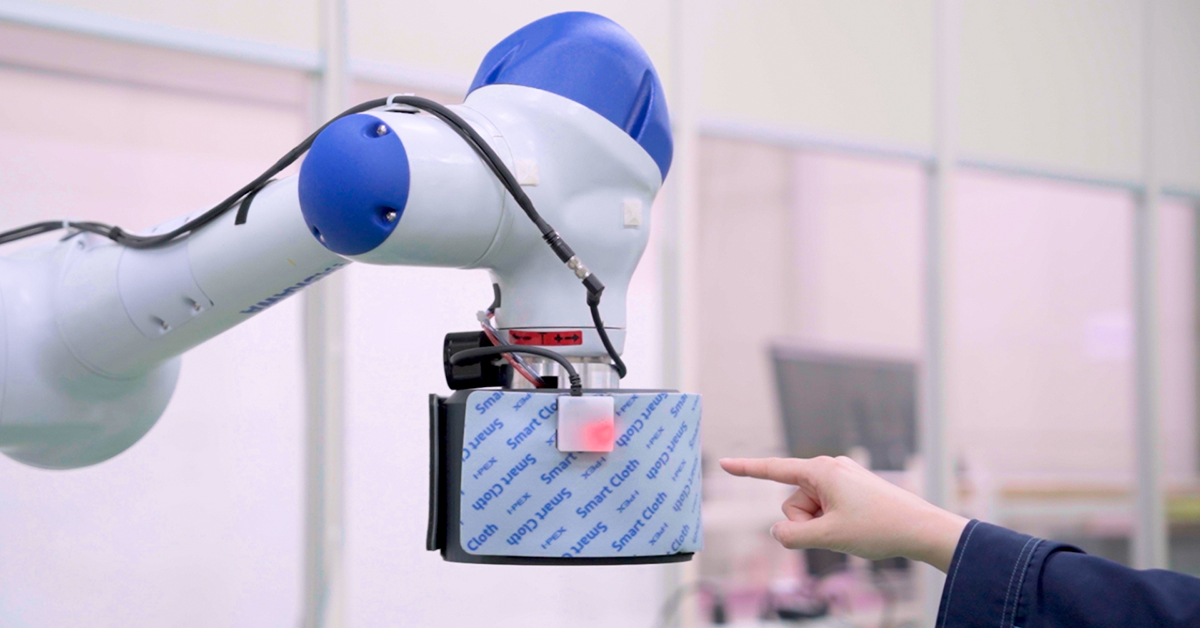
I-PEX's Smart Cloth offers a unique approach to addressing these on-site challenges. As the name suggests, it's a proximity sensor made of "fabric" *1 that is installed by wrapping it around the target area., with no drilling, no custom brackets, and none of the other machining that conventional sensors demand. It adapts seamlessly to curved or complex surfaces and is unbound by spatial limitations.
This article introduces the various applications of Smart Cloth, including its use in collaborative robots, transport robots, and manufacturing equipment.
- ※1A sensor that detects the approach or presence of an object without making physical contact.
What is Smart Cloth? A Flexible Fabric-Based Proximity Sensor
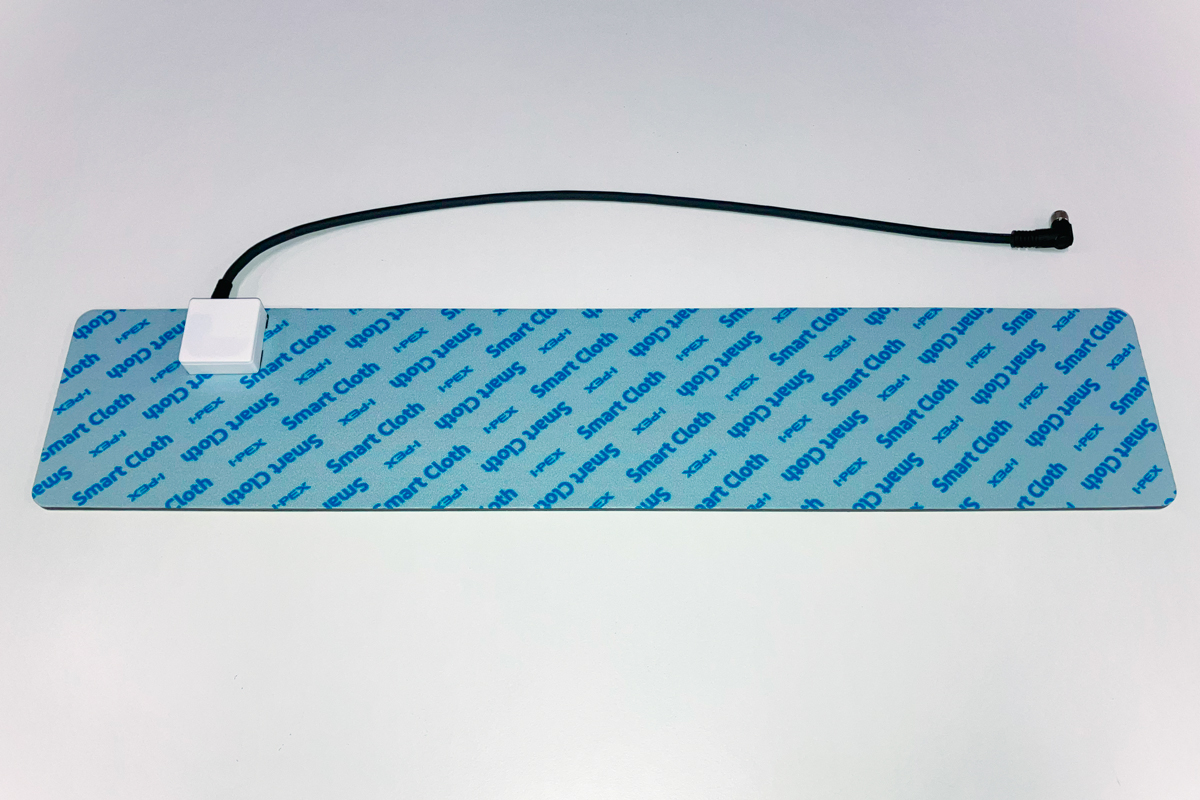
Smart Cloth, developed by I-PEX, is a capacitive proximity sensor *2 that uses electrically conductive fabric as a detection electrode *1. It reacts (switches) when an electrically conductive object, such as a human hand, approaches within approximately 15 cm.
The amplifier *3 is built in, so the sensor can be used simply by connecting it to the input terminal of a PLC *4 or controller.
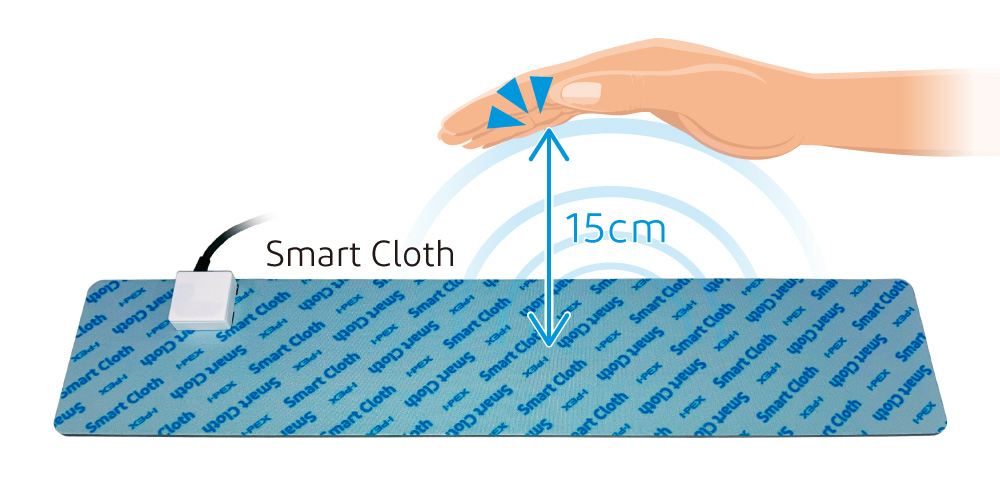
Smart Cloth's key feature is its fabric construction. Its inherent flexibility enables installation on any surface, no matter how curved or complex. It can also be easily retrofitted, eliminating the need for large-scale design modifications.
- ※1The conductive component used to electrically detect the approach of an object.
- ※2A detection method that captures changes in electrical capacitance produced when an object approaches.
- ※3A circuit that amplifies the weak electrical signal detected by the sensor and converts it into an output.
- ※4Programmable Logic Controller. An industrial computer for controlling the operation of production equipment.
Application Case ① Collaborative Robots | Safety Measures Around the End Effector
The Conventional Challenge
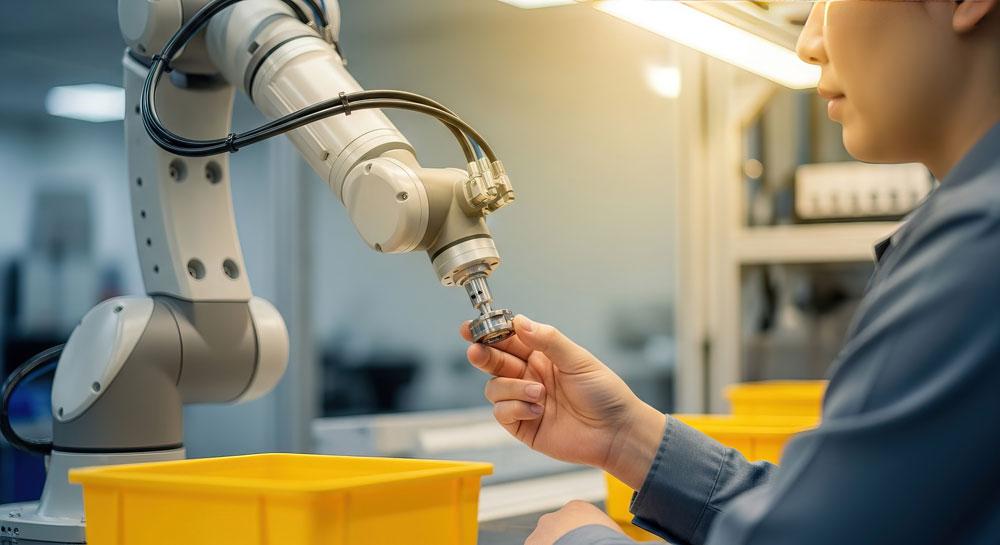
Collaborative robots are robots designed to operate alongside humans in the same workspace without safety fencing. While robot manufacturers have obtained safety certification up to the wrist of the robot body, the end effectors attached to the tip, such as tools and grippers *1, have traditionally been left to the user's own risk assessment.
The robot body itself is equipped with a torque sensor *2 and a contact detection function that monitors current, so the robot stops when it makes contact with an object. However, when the end effector is an electric drill, a sharp blade, or a tool for transporting heavy objects, "stopping after impact" is not enough to ensure safety. In February 2025, ISO 10218 *3 was revised to explicitly require risk assessments for collisions involving end effectors.
- ※1A gripping device attached to the tip of a robot arm, used to grasp and move objects.
- ※2A sensor that measures rotational force, used to detect the force generated when the robot comes into contact with an object.
- ※3An international safety standards for industrial robots.
The Solution with Smart Cloth
By wrapping Smart Cloth around the end effector, the robot can detect the presence of a person and stop before any physical contact occurs. Because it is made of fabric, Smart Cloth conforms to end effectors of complex shapes and can be retrofitted without additional design changes. It connects directly to a collaborative robot's existing safety input terminals *1 or general-purpose I/O terminals *2, eliminating the need for large-scale system modifications.
Robot manufacturers have expressed strong demand for early product development, and interest in this challenge is growing rapidly. For sites looking to enhance safety beyond current standards, Smart Cloth is an immediately effective option.
- ※1Safety input terminals are dedicated connection ports that receive signals from emergency stops and other safety equipment.
- ※2General-purpose I/O terminals are versatile input/output ports for exchanging signals with various sensors and devices.
Application Case ② AGVs, AMRs, and Service Robots | Complementary Detection for Top and Side Areas
The Conventional Challenge
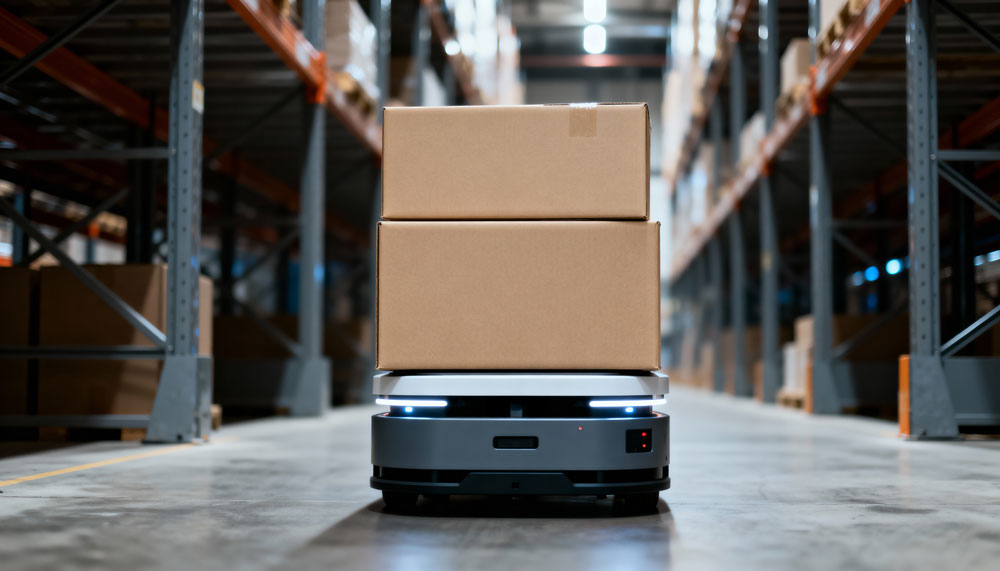
Transport robots used inside factories, such as AGVs (Automated Guided Vehicles) *1 and AMRs (Automated Mobile Robots) *2, and service robots such as food-serving robots in restaurants are equipped with LiDAR sensors*3 at floor level to detect approaching people. However, LiDAR can only detect within the floor-level area, and in practice it cannot cover approaches from the sides or above the robot.
For example, with food-serving robots in restaurant, there have been cases in which a child reaches out from a table and touches the top of the robot without the robot stopping. With AMRs in factories, accidents have also been reported in which a cargo-bed extending beyond the robot body comes into contact with a person.
- ※1Automated guided vehicles that automatically travel along predetermined routes.
- ※2Autonomous transport robot that navigates by recognizing its surroundings with sensors.
- ※3Sensor technology that uses laser light to measure the distance to surrounding objects.
The Solution with Smart Cloth
By installing Smart Cloth to the top, sides, and cargo-bed areas of the robot, it becomes possible to detect movement in areas that LiDAR cannot cover. This enables a three-dimensional safety design that protects the robot as a whole, dramatically improving safety in environments where people and transport robots coexist. Smart Cloth can be used simply by connecting it to the input terminal of the robot's controller.
Application Case ③ Molding Machines and Semi-Automatic Stamping Machines | An Added Layer of Safety for Light Curtains
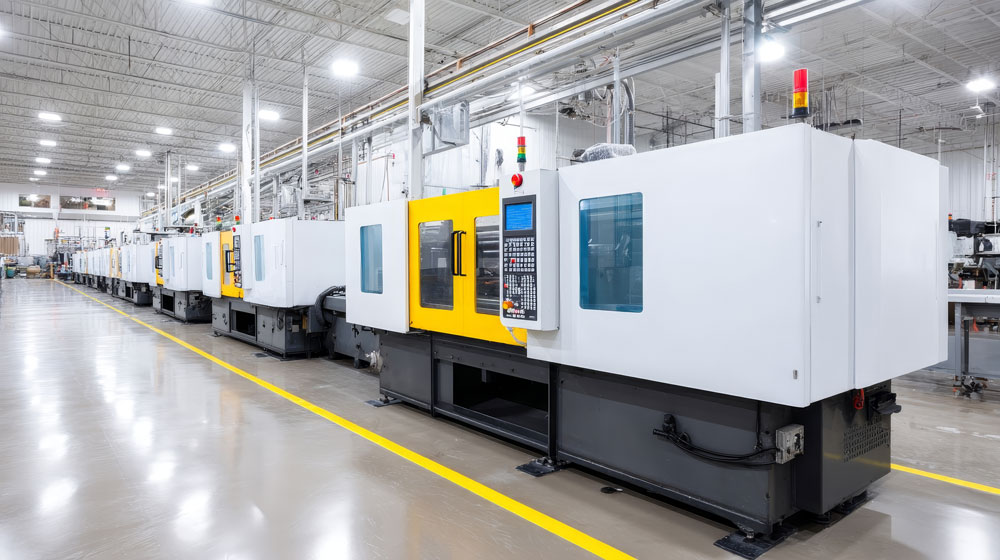
Safety measures for molding machines *1 and semi-automatic stamping machines *2 are required by ISO standards to address hazardous sources. By adding Smart Cloth to a light curtain, a representative example of such safety measures, an even higher level of safety can be achieved.
- ※1A manufacturing machine that pours materials such as resin or metal into a mold to form the shape of a product. Injection molding machines are the most representative type.
- ※2A stamping machine in which certain steps such as material loading are performed by a person, while the stamping and molding operations are carried out automatically by the machine.
Installation Around Light Curtains
One typical application is covering areas outside the detection range of light curtains installed at the doors of molding machines. Because light curtains are usually installed very close to the equipment, there are cases in which they cannot detect workers standing beside or around the equipment. By installing Smart Cloth around hazardous areas, these blind spots can be compensated for.
Potential Applicability to Semi-Automatic Stamping Machines
In semi-automatic stamping machines, two-hand control switches are adopted as the primary safety mechanism. The system prevents the stamping mold from lowering unless both switches are being pressed simultaneously, but the risk of switch failure or false detection is never zero. By installing Smart Cloth around pinch-point hazard zones, an additional safety measure becomes possible: even in the event of a switch malfunction, the approach of a human hand can be detected and the machine stopped.
Smart Cloth Features
A Major Advantage: It Can Be Attached Anywhere
Conventional non-contact human-detection sensors, such as LiDAR, radar, and photoelectric sensors*1 have always been limited in their installation locations. Smart Cloth has established a unique position in the proximity sensor market as a non-contact sensor that can be "attached anywhere" regardless of shape.
- ※1A sensor that detects the presence or absence of an object by detecting the blocking or reflection of light.
Four-Level Sensitivity Adjustment
The maximum detection distance is 150mm. The production version is planned to be configurable in four levels: 150mm, 80mm, 30mm, and 12mm. This sensitivity adjustment allows the sensor to be tailored to the noise conditions of the installation environment and to the specific application. Once installed, no further adjustment is required. In addition, the use of robot cables*1, ensures durability under flexing and repetitive motion.
- ※1Highly durable cables designed for robotic applications, built to withstand repeated bending and vibration.
A Safety 2.0 compliant products
Smart Cloth is currently sold as a product compliant with "Safety 2.0", a Japanese domestic safety standard. Safety 2.0 is a standard based on technical measures to realize "collaborative safety", the concept that people, objects, and environments share information through ICT*1 and work together to achieve safety. In contrast to the conventional approach of "separating people and machines" (Safety 1.0), Safety 2.0 aims to ensure safety while humans and machines coexist in the same space.
However, Safety 2.0 is positioned as something that "enables safer use". It is distinct from safety devices, such as lights curtains*2 which guarantee safety on their own. Smart Cloth is intended to be used as a supplementary sensor that is added to existing safety devices to raise the level of safety beyond the current standard.
- ※1Abbreviation for Information and Communication Technology
- ※2A safety device that emits multiple light beams in a planar array and stops the machine when the beams are blocked.
Product Lineup and Roadmap
The engineering samples currently on sale (as of June 2026) are being offered first as products for trial and evaluation purposes. They are available in a single size: 120mm x 600mm.
The mass-produced version, scheduled for release around July 2026, will feature an improved IP65 ingress protection*1 and support a 12-24V power supply. The mass-produced version will be available in the following three sizes:
- 120mm×600mm
- 100mm×400mm
- 120mm×800mm
These three sizes have been designed to cover a wide range of applications, from installation on small robotic hands to use with large palletizing robots*2. Furthermore, there are plans to obtain safety certification CAT.3/PLd*4 in accordance with ISO 13849-1*3, enabling Smart Cloth to address higher-level safety requirements in the future.
- ※1A rating system defined by an international standard for dust and water protection performance. IP65 indicates protection against dust ingress and resistance to water jets from any direction.
- ※2A robot that automatically stacks products and goods onto pallets.
- ※3International standards for safety-related control systems in machinery. These standards define the level of safety performance.
- ※4Safety category and performance-level classifications defined in ISO 13849-1. This ensures that safety functions are maintained even in the event of a single failure.
Other Potential Uses and Applications Cases

Application with High Potential
Automatic Door and Shutters / Equipment Doors
Potential applications include automatic doors and shutters in indoor environments. For example, Smart Cloth can provide supplementary detection of a person approaching while and automatic door is in the process of closing. It functions effectively as an added layer of safety on top of the interlock mechanism*1 of automatic doors and shutters.
Non-Contact Switching in Amusement Venues
In indoor amusement and experience facilities, Smart Cloth lends itself to non-contact switching applications such as "sound and light changing when someone approaches". As a mechanism for non-contact, interactive experience design, Smart Cloth will undoubtedly inspire the creative talent.
Non-contact Switches
In environments where hands esily become oily or dirty, touching a touchscreen or push button directly can be undesirable, requiring an extra "wipe your hands" step. By using Smart Cloth as a non-contact switch, operators can start production lines and activate equipment simply by bringing a hand close to them.
Furthermore, it can be applied to use cases such as detecting when a person enters a designated area to activate a monitor, or to automatically start the next process step. As a "human-responsive switch," Smart Cloth has the potential to appeal to a wide range of industries and sectors.
Use in Food Factories
Application to FA equipment*2in food factories is another possibility. When complying with food-industry standards, Smart Cloth can be adapted to comply, for example by changing the materials used. From the perspective of coordinated safety between people and equipment in food manufacturing sites, Smart Cloth offers an effective solution.
Entanglement Preventing on Belt Conveyors
Smart Cloth is also expected to be useful for preventing people from entanglement around belt conveyors in logistics and manufacturing environments. Detecting a person and stopping the conveyor is one specific application that can be anticipated.
- ※1A safety interlock mechanism that prohibits machine operation unless certain conditions are met.
- ※2Abbreviation for Factory Automation equipment. Machinery and equipment used to automate manufacturing processes.
Applications with Future Potential
Rider Detection (Contact Detection) for Ride-Type Attractions
In ride-type attractions (vehicles), there is a need to detect passenger seating positions and weight distribution and to use this information in control systems. While current use cases are envisioned around non-contact sensing, by leveraging the contact-detection function currently under development, it should become possible to monitor passenger seating positions in real time, reducing mechanical load caused by uneven weight distribution and improving the durability of the ride.
Medical and Nursing Care
Future applications in medical and nursing-care robots are also a future possibility. For example, on an autonomously driven wheelchair, Smart Cloth could be used as a sensor to detect whether the user is seated. Although compliance with medical device-specific standards would be required, there is ample potential for Smart Cloth to play an active role in medical and nursing-care settings where humans and machines work closely together.
Humanoid Robots
The deployment of humanoid robots inside factories is beginning to spread globally, and Smart Cloth has potential for application here as well. Currently, safety standards for humanoid robots are not yet fully established, but the need for safety sensing in robots that operate in the same space as humans clearly exists.
The Expanding Future of Smart Cloth Applications
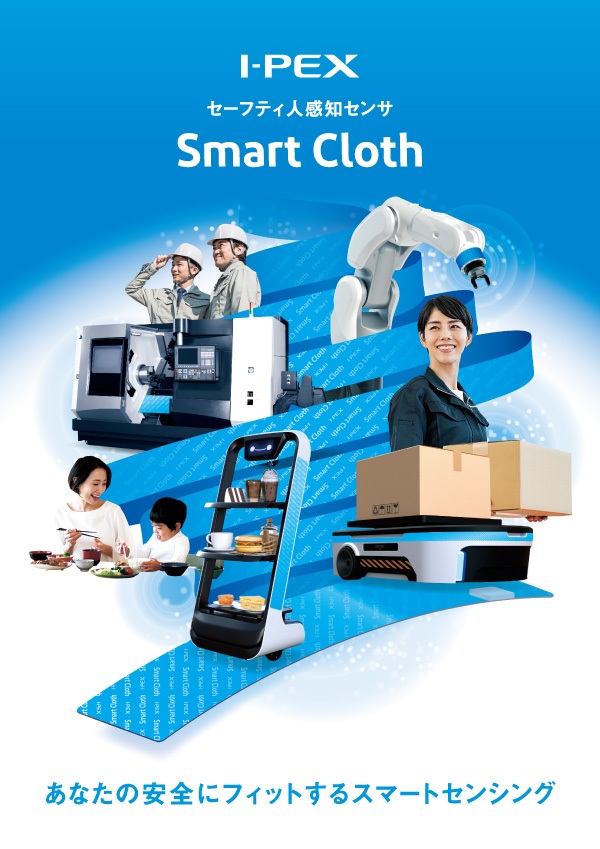
Smart Cloth is a capacitive proximity sensor that utilizes "fabric," a material that has traditionally received little attention until now. Its greatest strengths lie in its flexibility, which allows it to be attached regardless of shape, its ease of adoption through retrofitting, and its one-of-a-kind position as a "non-contact sensor that can be attached anywhere."
As a new solution supporting safe coexistence between humans and machines, Smart Cloth is expected to find use across a wide range of industries and applications. For inquiries or to explore adoption, please feel free to contact I-PEX.